
Rubber Testing & Performance Guides
Physical Testing Methods, Factory QC & Test Interpretation
Learn how footwear materials and rubber components are evaluated for hardness, compression set, tensile strength, abrasion, heat aging and slip resistance.
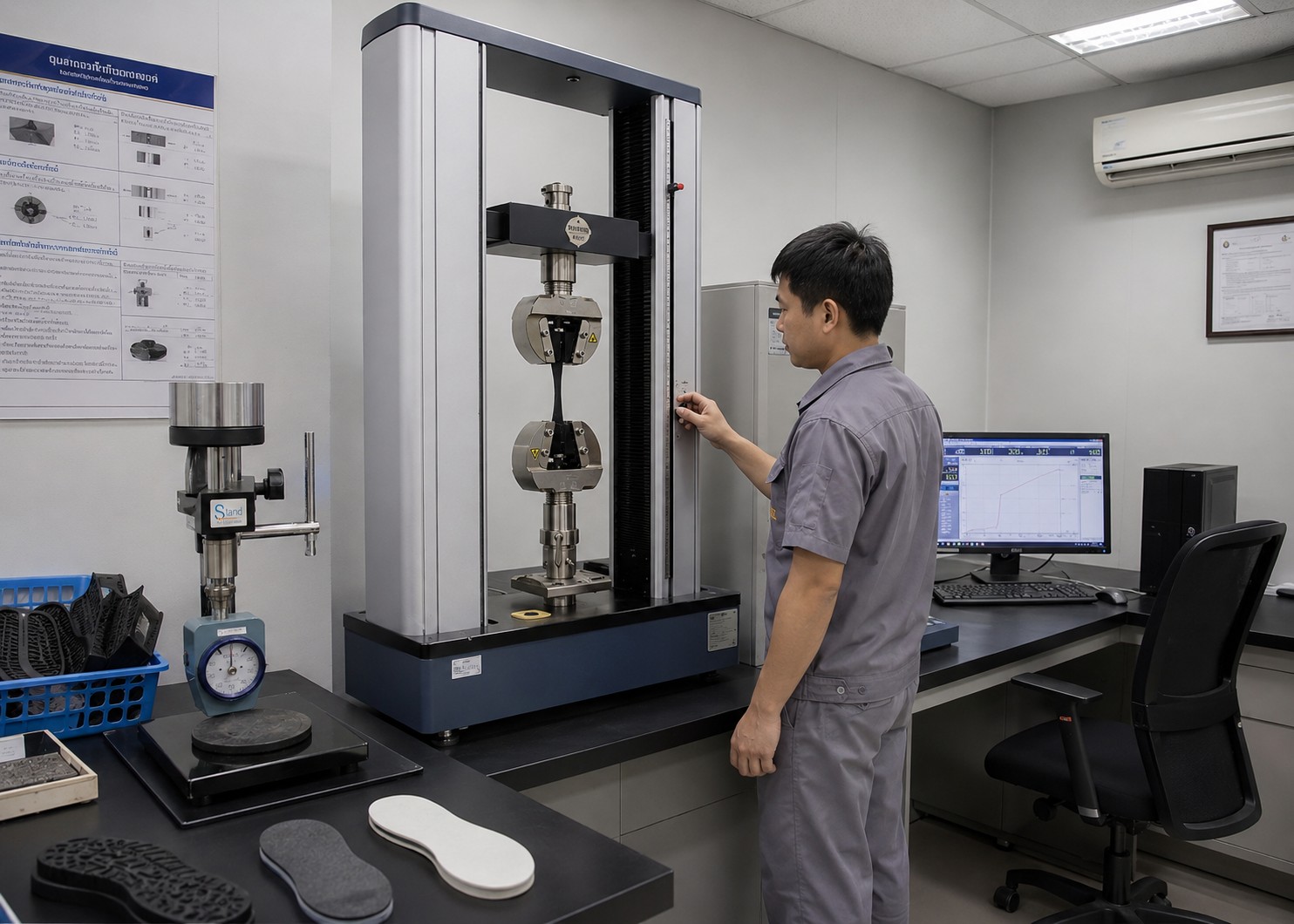
Key Practical Takeaways & Technical Focus
Example Natural Rubber Compound Test Results
Documented physical test results for a representative natural rubber formulation, tested using ASTM, ISO and DIN methods.
| Physical Property | Test Standard | Measured Result | Target Spec Range | Engineering Context |
|---|---|---|---|---|
| Tensile Strength | ASTM D412 | 13 MPa | ≥ 8 MPa | Tensile strength prevents chunking, tear-out, and structural breakdown under mechanical pull. |
| Elongation at Break | ASTM D412 | 510% | ≥ 350% | Demonstrates stretch recovery and dynamic footstep flexibility without permanent deformation. |
| Hardness (Durometer) | ASTM D2240 | 39 Shore A | 38–45 Shore A | Soft durometer formulation delivering high surface compliance and contact feel on smooth floors. |
| Tear Strength | ASTM D624 | 40 kN/m | ≥ 25 kN/m | Resists tear propagation along flex lines, perimeter trimming edges, and stitching holes. |
| Compression Set (22h @ 70°C) | ASTM D395 | 19% | ≤ 20% | Low compression set helps prevent permanent bottoming out over extended static loading. |
| Density / Specific Gravity | ASTM D792 | 1.11 g/cm³ | 1.00–1.15 g/cm³ | Controlled compound density balances durability, footbed stability, and finished component weight. |
| Abrasion Resistance | DIN 53516 / ISO 4649 | 140 mm³ | ≤ 200 mm³ | Low volumetric wear rate demonstrates compound abrasion resistance under rotary drum test friction. |
| Compression Deflection | ASTM D575 | 0.28 MPa | 0.20–0.40 MPa | Quantifies underfoot compliance and initial step-in pressure distribution. |
| Rebound Resilience | ISO 4662 / ASTM D2632 | 48% | ≥ 40% | Natural rubber elasticity returns energy during gait cycle while damping shock. |
| Flex Fatigue (100,000 Cycles) | ASTM D430 / SATRA TM60 | No crack after 100,000 cycles | No crack after 100,000 cycles | Demonstrates resistance to flex cracking across repetitive bending lines under laboratory test conditions. |
Need Specific Mechanical or Hardness Targets?
We compound natural and synthetic rubber formulations between 35 and 75 Shore A in Samut Prakan, Thailand.
What Matrix Route Checks During Factory QC
Routine factory QC may include Shore A hardness, thickness, weight or density, tensile properties, elongation and abrasion checks depending on the product and production requirements.
Shore A Hardness
Durometer measurement (ASTM D2240) across designated sole contact zones (forefoot, arch, heel)
Thickness
Digital caliper and depth gauge measurements of outsole web thickness, rim height, and tread lug depth
Weight / Density
Batch piece weighing and specific gravity checks (ASTM D792)
Tensile
Physical tensile testing of vulcanized specimen strips (ASTM D412)
Abrasion
Volumetric loss evaluation using rotary drum abrasion (DIN 53516 / ISO 4649)
Elongation
Ultimate elongation testing of vulcanized specimen strips (ASTM D412)
Have Specific Quality Inspection or Testing Requirements?
We can align our factory QC tolerances and coordinate external testing with your quality team.
Manufacturing Capability Snapshot
Verified operational facts for OEM footwear sole and component production.
In-House Mixing
Internal dispersion kneader mixer and two-roll open mill for custom natural and synthetic rubber formulations.
Compression Vulcanization
Hydraulic multi-daylight heated compression presses designed for durable outsole, midsole, and component molding.
35–75 Shore A
Formulation flexibility ranging from compliant footbed pads to firm, wear-resistant heel and shank components.
Factory Physical Checks
In-house checks for Shore A hardness, part thickness, density, tensile, elongation, and rotary drum abrasion.
Trial Molding & Coordination
Trial molding, sample inspection, and technical coordination with client or external mold-making partners.
1,500 Pairs / Style / Color
Typical MOQ approx. 300 pairs per size; monthly factory capacity up to 50,000 pairs based in Samut Prakan, Thailand.
Looking for a Reliable Rubber Sole OEM Partner?
Contact Matrix Route to discuss your footwear sole specifications and production requirements.
Technical Guides in Rubber Testing & Performance Guides
In-depth articles, material comparisons, and manufacturing standards for this topic.
Understanding Shore A Hardness for Rubber Soles
Shore A hardness measures the resistance of rubber to indentation under defined test conditions. It does not directly measure comfort, cushioning, grip, abrasion resistance, durability, compression recovery, or walking performance. Two rubber soles with exactly the same Shore A value may perform very differently because hardness represents only one characteristic of a complete rubber compound. For B2B sourcing, Shore A should be specified together with other engineering requirements rather than used as the only acceptance criterion.
Grip Design for Polished Marble & Tile Surfaces
Grip on polished marble and glazed tile is created by the interaction of the sole compound, tread geometry, contact pressure, walking phase, floor finish and surface contamination.
Heat Resistance for Rubber Soles in Hot Climates
Heat-resistant footwear soles are not defined by material name or Shore A hardness alone. A rubber sole intended for hot-climate markets should be engineered and validated for changes in hardness after heat exposure, retention of tensile strength and elongation, compression recovery under load, dimensional stability, flex-crack resistance, abrasion behaviour, adhesive-bond durability, surface appearance and odour, and finished-footwear performance.
B2B Buyer’s Guide: Comparing Footwear Sole Materials for Hot-Climate Markets
Natural rubber, synthetic rubber, EVA, TPU and PVC offer different trade-offs in weight, flexibility, abrasion behavior, compression recovery, grip potential, production requirements and cost. Natural rubber can be a strong option for sandal outsoles, dress-shoe soles and flexible molded footwear components when its compound, hardness, thickness and tread design are developed for the intended use. EVA is commonly selected where lightweight cushioning is a priority, particularly in midsoles. Synthetic rubbers may be appropriate when properties such as oil resistance, abrasion behavior or formulation control are important. TPU and PVC can support repeatable molded production and specific commercial requirements, although their suitability depends heavily on polymer grade, hardness and product construction.
Have Questions About Rubber Testing & Performance Guides?
Matrix Route supports OEM manufacturing and custom rubber compound development. Discuss your target material specs, hardness, and production volume with our technical team.