
Rubber Sole Manufacturing for Middle East & Hot-Climate Footwear
Hot-Climate Compounds, Grip on Polished Floors & Sandal Architecture
Rubber soles for Middle East and hot-climate footwear must balance heat stability, traction on smooth indoor surfaces, flexibility, abrasion resistance and application-specific geometry. Material selection alone is not enough; compound formulation, tread design, hardness and validation need to be considered as one system.
Key Practical Takeaways & Technical Focus
Hot-Climate & Middle East Footwear Manufacturing Framework
Product performance in GCC and Middle East markets depends on the interaction between environment, material, geometry, surface conditions and validation—not on one material property alone.
Factor 1 — Thermal Environment
High ambient and surface temperatures can affect compound aging, dimensional stability, bonding and long-term sole performance. Study compounding principles in heat resistance for hot-climate rubber soles.
Factor 2 — Indoor Surface Traction
Polished marble and glazed tile require attention to rubber friction behavior, contact geometry and tread design. Explore siping and contact area in grip design for polished marble and tile.
Factor 3 — Compound & Hardness Selection
Hardness must be balanced with grip, flexibility, abrasion resistance and the target footwear application. Calibrate durometer targets in Shore A hardness for rubber soles, or review broader footwear sole materials.
Factor 4 — Arabic Sandal Architecture
Traditional and modern Arabic sandal designs require attention to weight distribution, outsole geometry, support and flex behavior. Review ergonomics in Arabic sandal weight distribution and support.
Factor 5 — Product Validation
Hot-climate products should be evaluated through material testing, prototype review and application-specific validation before mass production. Follow our end-to-end guide on hot-climate rubber sole design and validation.
Rubber Sole Considerations for Middle East & Hot-Climate Footwear
Practical manufacturing solutions for high ground heat, smooth indoor flooring, and Arabic sandal architecture.
1. Conductive Ground Heat & Solar Exposure
2. Friction on Polished Marble & Glazed Tile
3. Arabic Sandal Underfoot Weight Distribution
4. Dynamic Flex Fatigue Along Sandal Flex Lines
5. Elevated Temperature Adhesive Bonding Stability
6. Thermal & Photolytic Aging Resistance
Developing Soles for Middle Eastern or Tropical Markets?
Discuss compound formulation, heat resistance, and sandal sole tooling with our engineering team.
Shore A Hardness for Rubber Soles
Understanding durometer selection, performance trade-offs, and factory compounding capabilities.
What Does Shore A Measure?
Shore A durometer (measured per ASTM D2240 / ISO 48-4) quantifies the resistance of vulcanized rubber to surface indentation by a calibrated indentor pin under spring force. A lower number indicates a softer, more compliant material, while a higher number indicates a stiffer, more rigid elastomer.
Why Hardness Alone Is Not Enough
Shore A hardness is one design variable. Grip, abrasion resistance, flexibility and durability also depend on polymer system, compound formulation, fillers, tread geometry, processing and intended application. Two compounds measuring the same Shore A value can perform differently in service.
Hardness Ranges & Practical Applications
Softer compound feel with high surface compliance; often provides high tactile friction on smooth surfaces.
Soft footbeds, high-compliance sandal outsoles, slip-resistant indoor pads, cushioning inserts.
May require thicker lug bases or careful geometry design to prevent lug deflection under lateral shear loads.
Balanced combination of flexibility, wear properties, and structural feel across common walking surfaces.
Casual shoe outsoles, athletic sneaker bottoms, traditional Arabic sandal outsoles, dress shoe outsoles.
The most commonly specified range; grip and abrasion performance depend on compound formulation and tread geometry.
Harder compound feel providing firm dimensional stability, puncture resistance, and rigid structural profile.
Separate heel lifts, toplifts, dress shoe heel blocks, protective outer rims, torsion support components.
Lower surface compliance on smooth tile; typically specified for rigid support areas rather than flexible forefoot zones.
Need Help Selecting Target Durometer for Your Soles?
Discuss target hardness, sample testing, and compound formulation with our factory team.
Manufacturing Capability Snapshot
Verified operational facts for OEM footwear sole and component production.
In-House Mixing
Internal dispersion kneader mixer and two-roll open mill for custom natural and synthetic rubber formulations.
Compression Vulcanization
Hydraulic multi-daylight heated compression presses designed for durable outsole, midsole, and component molding.
35–75 Shore A
Formulation flexibility ranging from compliant footbed pads to firm, wear-resistant heel and shank components.
Factory Physical Checks
In-house checks for Shore A hardness, part thickness, density, tensile, elongation, and rotary drum abrasion.
Trial Molding & Coordination
Trial molding, sample inspection, and technical coordination with client or external mold-making partners.
1,500 Pairs / Style / Color
Typical MOQ approx. 300 pairs per size; monthly factory capacity up to 50,000 pairs based in Samut Prakan, Thailand.
Looking for a Reliable Rubber Sole OEM Partner?
Contact Matrix Route to discuss your footwear sole specifications and production requirements.
Moving from hot-climate material research to full OEM project execution? Matrix Route delivers end-to-end Middle East OEM and export support covering compound formulation, tooling mold development, sample approval, and export-ready mass production for Middle Eastern brand owners and footwear factories.
Technical Guides in Hot-Climate & Middle East Footwear Guides
In-depth articles, material comparisons, and manufacturing standards for this topic.
Hot-Climate & Middle East Footwear Engineering Guide
Developing footwear components for hot climates and Middle East markets requires more than selecting a rubber compound described as "heat resistant." The sole must function as part of a complete footwear system under conditions that may include high ambient temperature, heated outdoor walking surfaces, air-conditioned indoor environments, repeated transitions between hot and cool conditions, smooth marble/tile flooring, dust and fine sand, long storage and transportation periods, and high visual/finishing expectations for Arabic sandal and dress-shoe constructions.
Heat Resistance for Rubber Soles in Hot Climates
Heat-resistant footwear soles are not defined by material name or Shore A hardness alone. A rubber sole intended for hot-climate markets should be engineered and validated for changes in hardness after heat exposure, retention of tensile strength and elongation, compression recovery under load, dimensional stability, flex-crack resistance, abrasion behaviour, adhesive-bond durability, surface appearance and odour, and finished-footwear performance.
Arabic Sandal Weight Distribution & Underfoot Support
Arabic sandals achieve long-term walking comfort not because they are inherently softer, but because their outsole geometry, material properties, weight distribution, and structural support work together to manage how forces travel through the foot during walking.
Grip Design for Polished Marble & Tile Surfaces
Grip on polished marble and glazed tile is created by the interaction of the sole compound, tread geometry, contact pressure, walking phase, floor finish and surface contamination.
Two-Piece Rubber Sole Design & Manufacturing
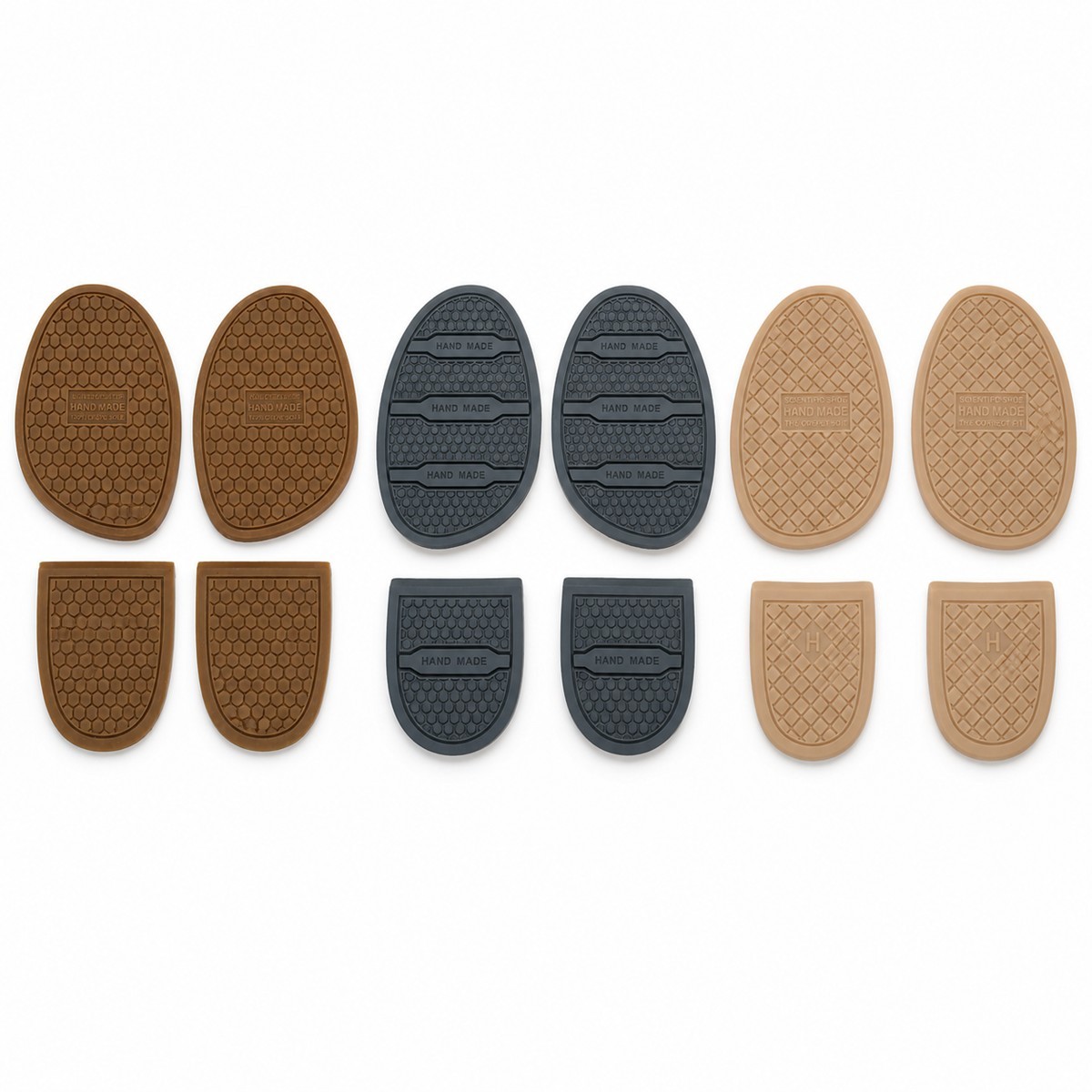
A two-piece rubber sole uses separate rubber components beneath the heel and forefoot rather than one continuous rubber outsole covering the entire bottom of the footwear.
Have Questions About Hot-Climate & Middle East Footwear Guides?
Matrix Route supports OEM manufacturing and custom rubber compound development. Discuss your target material specs, hardness, and production volume with our technical team.