
Footwear Sole Engineering & Outsole Architecture
Outsole Geometry, Ground Traction & Structural Component Design
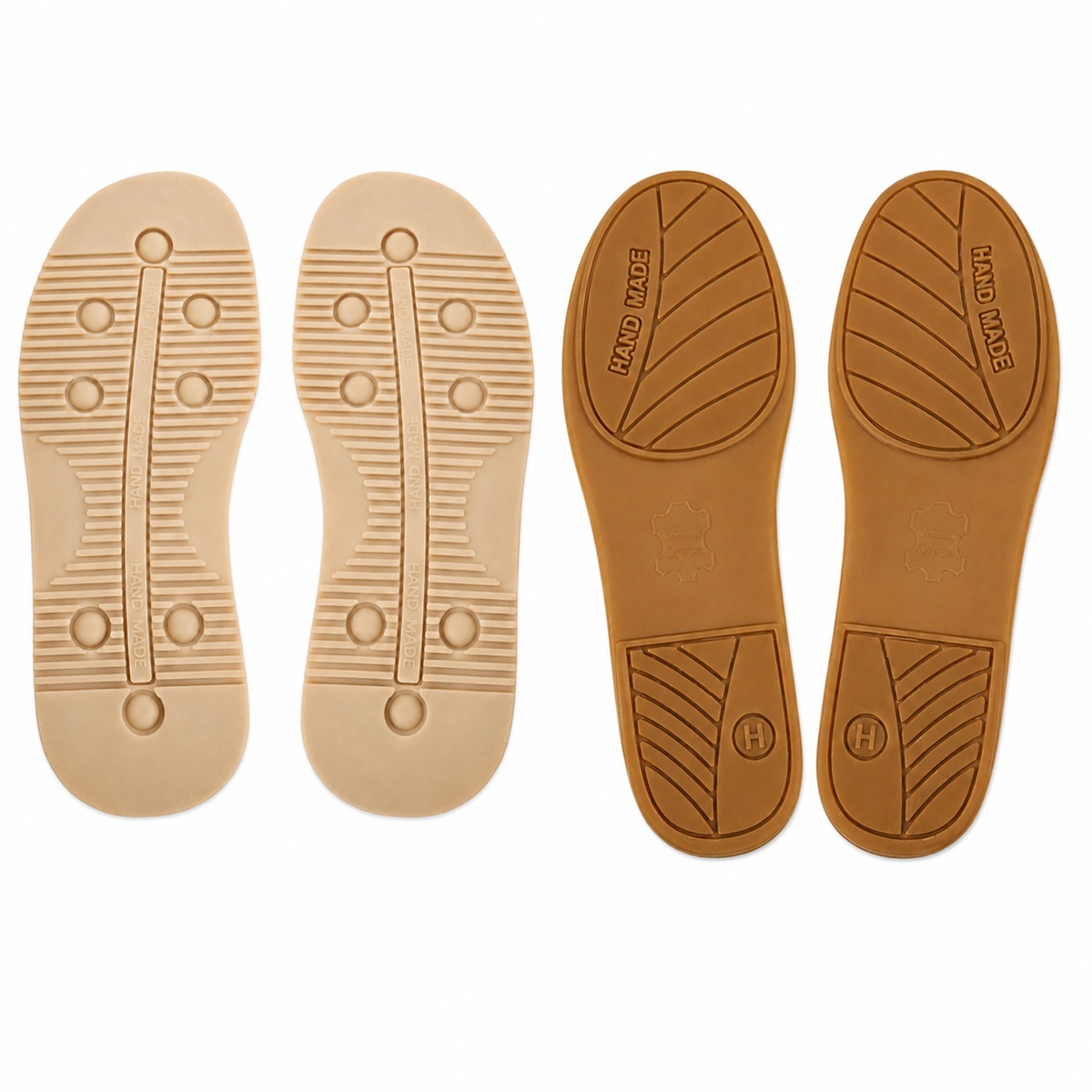
Footwear sole engineering is the practical integration of outsole geometry, elastomer compound properties, underfoot weight distribution, and manufacturing processes. It bridges material science and functional design to optimize surface traction, flex-fatigue life, impact cushioning, and mold tooling efficiency across casual, formal, and hot-climate footwear lines.
Key Practical Takeaways & Technical Focus
Five Practical Factors in Footwear Sole Engineering
Effective sole development requires balancing mechanical geometry, ground interaction, material response, and tooling feasibility rather than treating outsole design as purely visual styling.
Factor 1 — Tread Geometry & Surface Interaction
Ground contact area, channel depth, and tread pitch govern friction on smooth and contaminated floors. Compare siping mechanics in our guide on grip design for polished marble and tile.
Factor 2 — Load Distribution & Underfoot Support
Heel strike cushioning and metatarsal load dispersion dictate standing and walking comfort, especially in open-profile footwear. Review arch geometry in Arabic sandal weight distribution and support.
Factor 3 — Flexibility & Bending Behavior
Forefoot flex grooves must align with natural joint articulation while resisting edge tearing and flex cracking. Explore low-profile flex engineering in natural rubber dress shoe soles and our material selection guide.
Factor 4 — Sole Architecture & Component Integration
Modular two-piece outsoles separate heel and forefoot tooling to enhance natural gait articulation and reduce mold costs. Learn engineering workflows in two-piece rubber sole design and manufacturing.
Factor 5 — Material–Geometry–Manufacturing Interaction
Outsole performance cannot be determined by material alone; cross-sectional thickness, draft angles, and vulcanization shrinkage must be co-engineered with compound formulation. Learn more in our footwear sole materials hub.
Outsole Design Trade-Offs
Every outsole architectural decision involves mechanical trade-offs between surface friction, wear longevity, finished footwear weight, and mold tooling complexity. The table below outlines core design choices and their engineering implications for commercial footwear lines.
| Design Choice | Potential Benefit | Possible Trade-Off |
|---|---|---|
| Deeper tread channels & aggressive lug profile | Enhanced water evacuation, debris shedding, and mechanical interlocking on uneven outdoor terrain. | Reduced true contact patch area on polished indoor flooring; increased finished component weight and tooling complexity. |
| Broad contact patches with micro-siping | Maximized surface friction on smooth indoor floors (marble, polished tile, ceramic) and quiet, vibration-damped footfall. | Faster visible tread wear under coarse outdoor abrasion; requires precise compound hardness to prevent lug squirm and edge deformation. |
| Softer compound durometer (lower Shore A) | Enhanced surface compliance, superior instantaneous dry and wet grip, and higher initial step-in cushioning. | Higher volume loss under abrasive cyclic friction; potential for accelerated flex-line fatigue if groove radii are sharp. |
| Thicker monolithic sole cross-section | Extended service life, robust barrier against conductive ground heat from hot paving, and superior puncture resistance. | Increased finished shoe weight, higher longitudinal bending stiffness, and longer compression vulcanization cycle times. |
| Modular two-piece (forefoot & heel) construction | Unconstrained longitudinal arch flexibility, independent material density optimization per foot zone, and refined aesthetic contrast. | Requires multi-cavity tooling sets, precise lasting alignment fixtures, and dedicated adhesive bonding protocols. |
Engineering Considerations for Commercial Footwear Lines
Transitioning an outsole concept from 2D aesthetic rendering to mass-producible tooling requires rigorous engineering coordination. Outsole geometry cannot be designed in isolation from the molding process and elastomer rheology:
- Mold Draft & Demolding Physics: Adequate mold draft should be engineered around part geometry, compound flow behavior, tread depth, and demolding orientation to support reliable release without tearing vulcanized edges during high-speed production cycles.
- Flex Line Stress Dispersion: Flex grooves should avoid unnecessarily sharp internal transitions because localized mechanical stress concentrations can accelerate crack initiation under repetitive bending. Groove geometry and root transitions should be selected in tandem with compound flexibility, sole thickness, and anatomical flex locations, as detailed in our guide on formal dress shoe sole development.
- Regional Friction Dynamics: Footwear destined for commercial buildings with polished marble, limestone, or terrazzo must incorporate continuous perimeter damming and micro-siped central pads. Explore quantitative friction principles in grip design for polished marble and tile.
- Modular Assembly Integration: Two-piece sole architectures allow footwear brands to reduce unneeded rubber mass in the arch shank while providing dedicated heel cushioning. Learn tooling and bonding parameters in two-piece rubber sole design and manufacturing, or explore material compounding options in our footwear sole materials hub.
Shore A Hardness for Rubber Soles
Understanding durometer selection, performance trade-offs, and factory compounding capabilities.
What Does Shore A Measure?
Shore A durometer (measured per ASTM D2240 / ISO 48-4) quantifies the resistance of vulcanized rubber to surface indentation by a calibrated indentor pin under spring force. A lower number indicates a softer, more compliant material, while a higher number indicates a stiffer, more rigid elastomer.
Why Hardness Alone Is Not Enough
Shore A hardness is one design variable. Grip, abrasion resistance, flexibility and durability also depend on polymer system, compound formulation, fillers, tread geometry, processing and intended application. Two compounds measuring the same Shore A value can perform differently in service.
Hardness Ranges & Practical Applications
Softer compound feel with high surface compliance; often provides high tactile friction on smooth surfaces.
Soft footbeds, high-compliance sandal outsoles, slip-resistant indoor pads, cushioning inserts.
May require thicker lug bases or careful geometry design to prevent lug deflection under lateral shear loads.
Balanced combination of flexibility, wear properties, and structural feel across common walking surfaces.
Casual shoe outsoles, athletic sneaker bottoms, traditional Arabic sandal outsoles, dress shoe outsoles.
The most commonly specified range; grip and abrasion performance depend on compound formulation and tread geometry.
Harder compound feel providing firm dimensional stability, puncture resistance, and rigid structural profile.
Separate heel lifts, toplifts, dress shoe heel blocks, protective outer rims, torsion support components.
Lower surface compliance on smooth tile; typically specified for rigid support areas rather than flexible forefoot zones.
Need Help Selecting Target Durometer for Your Soles?
Discuss target hardness, sample testing, and compound formulation with our factory team.
What Happens During Trial Molding?
The 7-step sampling, inspection, and tooling coordination process before mass rubber sole production.
Mold Received
Tooling is received from the client or external mold-making partner, inspected for cavity cleanliness, alignment pins, and mounting compatibility with factory compression press platens.
Trial Molding
Trial compound batches mixed on internal kneader and two-roll mill are loaded into mold cavities and vulcanized under defined heat, pressure, and cure time parameters.
Sample Inspection
Molded trial soles are demolded, trimmed, and inspected for molded dimensions, visual appearance, surface finish, and hardness.
Tooling Issue Identification
Any molding irregularities—such as localized air entrapment, incomplete filling, excessive parting line flash, or demolding binding—are identified and documented.
Coordination with Mold Maker if Correction Required
If tooling-related issues or dimensional adjustments are identified during trial molding, Matrix Route coordinates with the mold maker for correction before production approval.
Production Approval
A trial sample meeting approved product requirements is reviewed and confirmed before scheduling mass production.
Mass Production
Mass compression molding commences using the approved mold and standardized compounding parameters.
Have Existing Molds or Sourcing Tooling?
We can conduct trial molding pressings and sample inspection with your supplied footwear molds.
Footwear sole engineering requires balancing underfoot ergonomics and mechanical stability, from custom footbed pressure relief in Arabic sandal weight distribution and support to low-profile, high-traction compound development for natural rubber soles for dress shoes.
Technical Guides in Footwear Sole Engineering
In-depth articles, material comparisons, and manufacturing standards for this topic.
Two-Piece Rubber Sole Design & Manufacturing
A two-piece rubber sole uses separate rubber components beneath the heel and forefoot rather than one continuous rubber outsole covering the entire bottom of the footwear.
Arabic Sandal Weight Distribution & Underfoot Support
Arabic sandals achieve long-term walking comfort not because they are inherently softer, but because their outsole geometry, material properties, weight distribution, and structural support work together to manage how forces travel through the foot during walking.
Grip Design for Polished Marble & Tile Surfaces
Grip on polished marble and glazed tile is created by the interaction of the sole compound, tread geometry, contact pressure, walking phase, floor finish and surface contamination.
Natural Rubber Soles for Dress & Formal Footwear
Natural rubber can be an excellent outsole material for dress shoes, formal sandals, premium slippers and traditional leather footwear when the compound and outsole design are developed specifically for formal applications.
Have Questions About Footwear Sole Engineering?
Matrix Route supports OEM manufacturing and custom rubber compound development. Discuss your target material specs, hardness, and production volume with our technical team.